Know exactly where you stand before the conversation.
A structured self-assessment system for mapping your capabilities against the next level — identifying gaps, building evidence, and arriving at every career conversation with a clear, defensible picture of where you are and where you're going.
One-time payment. Yours forever.
- ✓Capability Self-Assessment
- ✓Level Comparison Matrix
- ✓Evidence Library Builder
- ✓Gap Analysis Planner
- ✓Promotion Argument Builder
- ✓Development Roadmap
Most career conversations fail before they start — because neither side has a clear picture.
You know you're performing at the next level. You've been doing work above your grade for months. But when the conversation comes, you're making a general claim — "I think I'm ready" — against a vague framework that nobody has ever been fully transparent about.
Your manager nods. They say they'll think about it. They come back with feedback about a couple of areas to develop. The goalposts have moved again and you still don't know where they are.
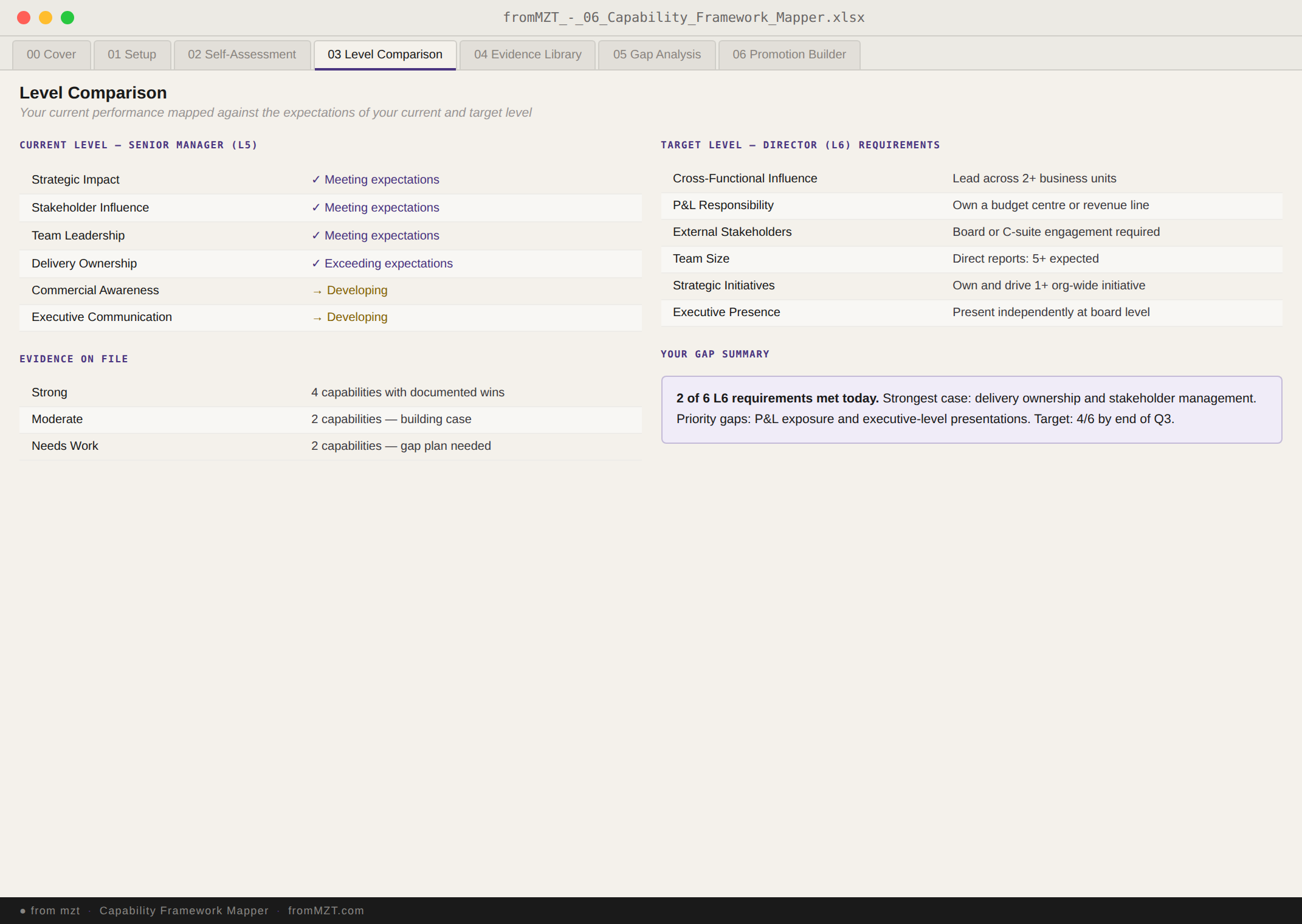
The Capability Framework Mapper solves this by giving you a structured, evidence-based picture of your current position — so you're not asking for a promotion based on feeling ready, but demonstrating that you're already operating at the level.
The numbers behind the problem — and why it matters.
Five tabs. From where you are to where you need to be — with a plan, not a guess.
swipe to explore tabs
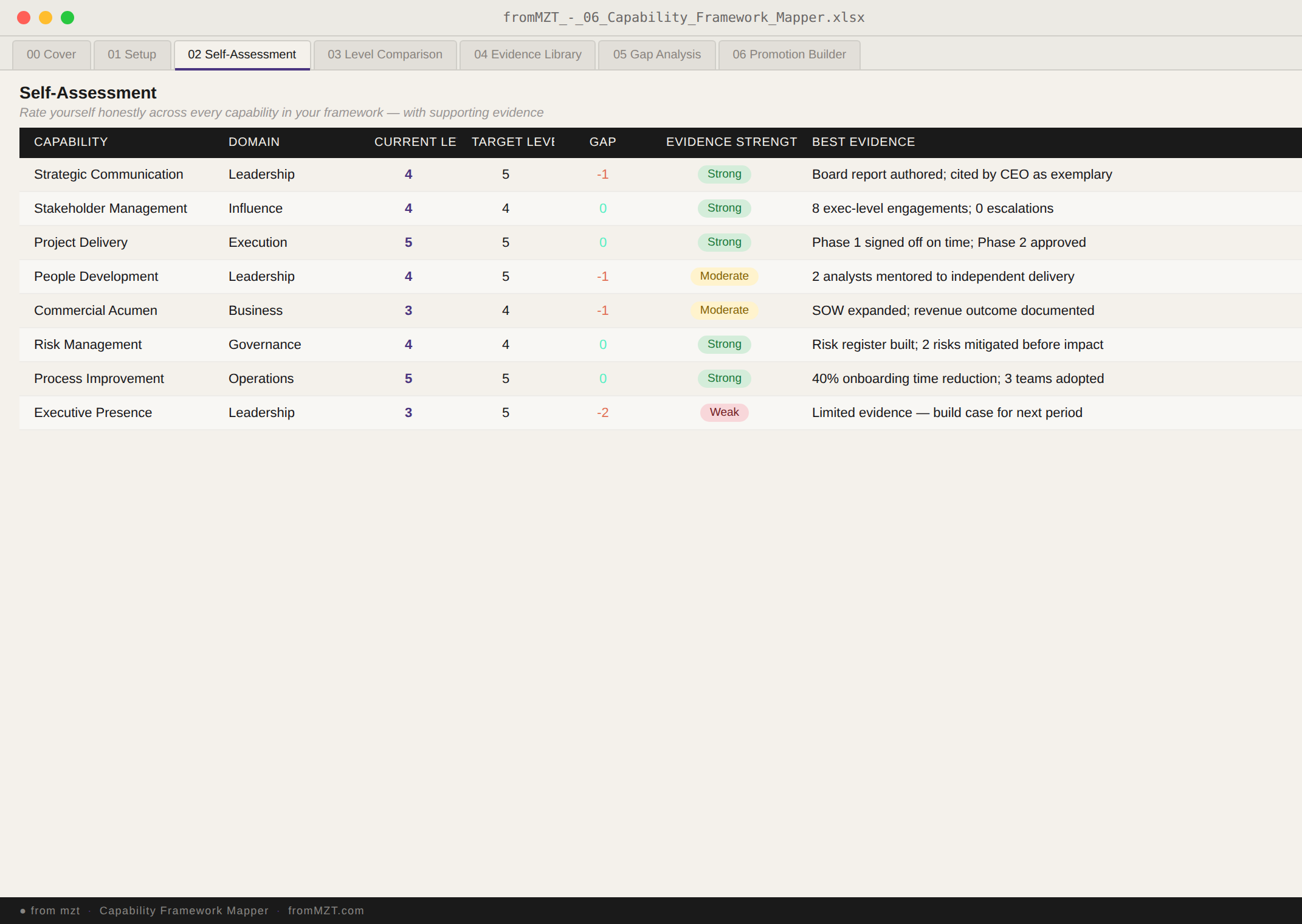
Capability Ratings
Rate your current and target level for each capability (1–5). Gap auto-calculates. Set priority (Critical / High / Medium / Low) — this drives your Development Plan and gap analysis automatically.
The honest self-assessment that turns development conversations from vague to specific.
- Domain and capability name
- Current rating and target rating (1–5)
- Gap auto-calculates — drives everything downstream
- Evidence strength: Strong / Partial / Weak / None
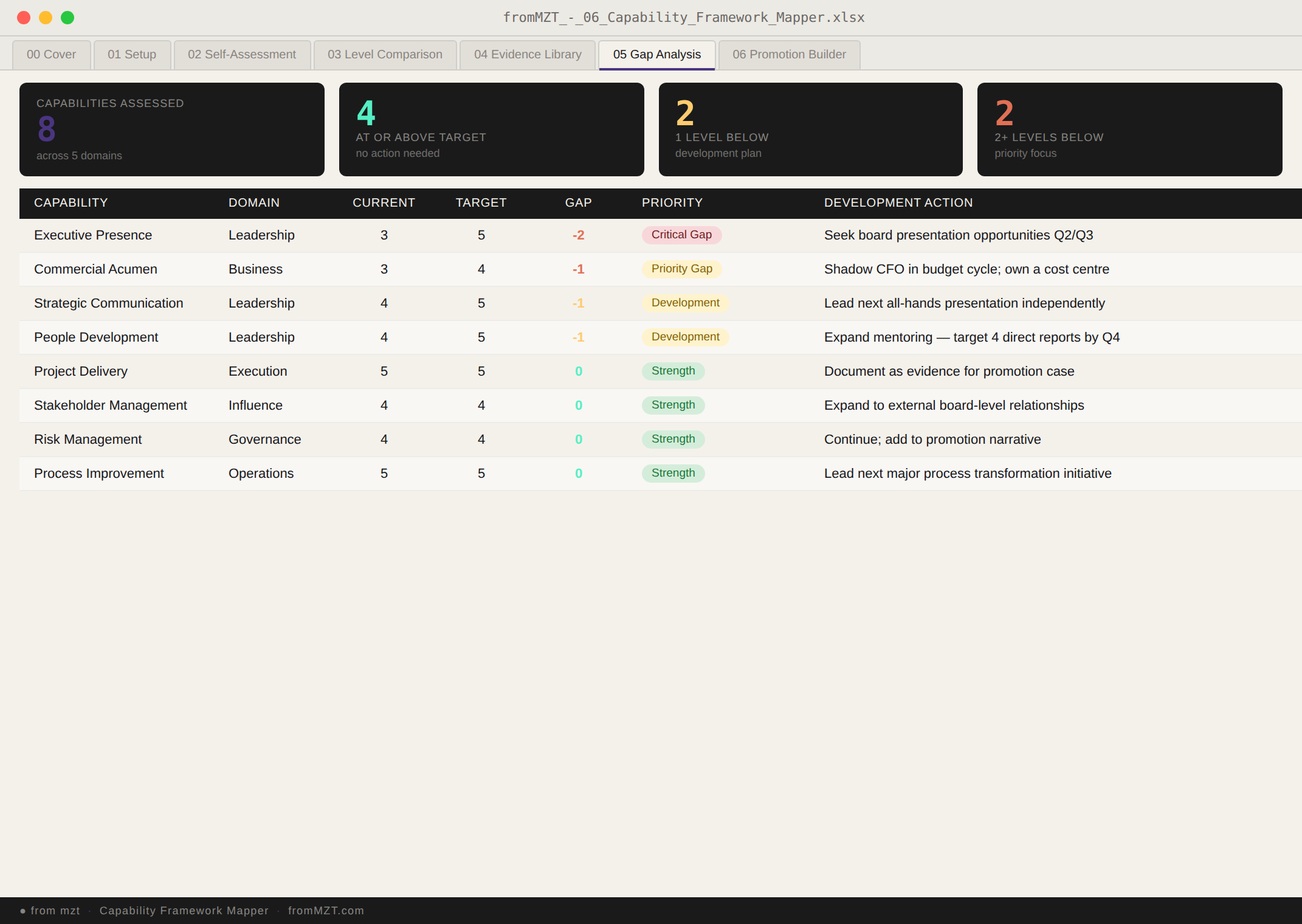
Gap Analysis
Your capability gaps ranked by priority and gap size. Critical gaps with large scores and weak evidence are your highest-leverage development opportunities — the analysis shows you where to focus first.
Development without gap analysis is effort without direction.
- Gaps ranked by priority × gap size
- Evidence strength overlay
- Critical vs High vs Medium priority split
- Auto-populated from Capability Ratings — no manual input
Development Actions
One specific action per capability gap. Clear success measures and deadlines. This is the engine of your development — vague actions produce no change, and this sheet doesn't allow vague actions.
The plan that turns a gap into a closed gap.
- One action per capability, with clear success measure
- Due date and status: Not Started / In Progress / Completed
- Development type: Course / On-the-job / Mentoring / Project
- Linked to capability and priority from Ratings tab
Progress Tracker
Period-on-period rating movement for every capability. Update the current period column after each review. Trajectory matters as much as the number — this tab shows whether you're improving, plateauing, or sliding.
Your capability growth record across every review period.
- One column per review period
- Trend = latest period minus previous period
- vs Target = latest period minus target rating
- Visual trajectory — improving / stable / declining
Development Plan
Your complete capability development summary, auto-populated from your Ratings and Actions. Fill in three sections — career goal, development focus, and manager support needed. Everything else generates from your data.
Print and bring to every review. The plan that makes development conversations concrete.
- Three input fields: career goal, focus, manager support
- Everything else auto-populates from your data
- Top-priority gaps and planned actions in one view
- Print-ready — designed to share with your manager or mentor
Real situations this was designed to solve.
You've been told you need to "demonstrate more strategic thinking" before being considered for promotion. Nobody has told you what that means in practice. It's the third time you've heard it.
Your capability mapper gives you a framework for what strategic thinking looks like at each level. You build evidence against specific criteria. The conversation gets specific.
You were told last cycle that you had two development areas. You've addressed both. Now there are new ones. You can't tell if the criteria are shifting or if you're genuinely not there yet.
You have a documented self-assessment from each cycle, evidence mapped to the original criteria, and a comparison that shows what changed. The conversation is grounded in data.
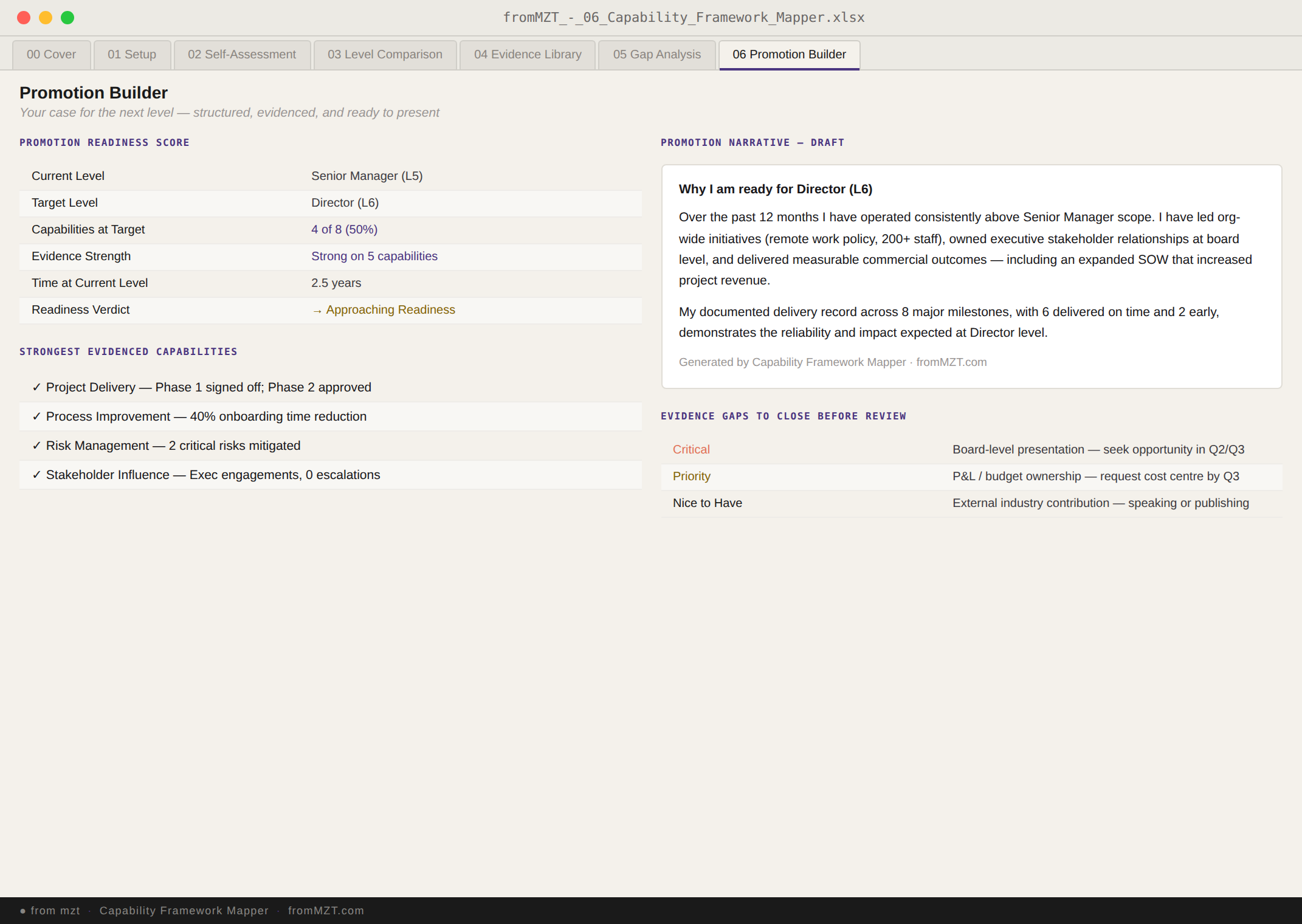
Your manager is supportive but they're not strong at advocating upward. When they go to the calibration meeting, they can't make your case as well as you'd make it yourself. Your promotion fails at the level above.
Your promotion argument builder produces a document your manager can use. The evidence is organised. The case is clear. They can advocate effectively because the material does the work.
You're not going for promotion this cycle but you want to be unambiguously ready for the next one. You don't know how to build a plan that actually closes the gaps rather than just looking busy.
Your development roadmap identifies the specific evidence you need to build over 12 months. Every quarter has a checkpoint. By next cycle, the case is already made.